What Actually Makes a Great Golf Bag? A Buyer's Framework.
The Golf Bag Buying Process Is Broken. Here's How to Fix It.
Most golfers buy their bag the same way they buy most things: they search "best golf bags," read three or four affiliate review sites that all recommend the same seven bags with slightly different ordering, pick one that feels right based on price and brand recognition, and buy it.
Two years later, the zipper fails. The base panel compresses. The strap padding collapses. They do it again.
The problem isn't that golfers are making bad decisions. The problem is that they're making decisions without a framework — without knowing which variables actually determine long-term satisfaction and which are marketing noise.
This page gives you that framework. It's written by a brand that had to understand golf bags deeply enough to rebuild them from scratch. We have an obvious stake in how you evaluate your next bag — but the framework itself is honest, because golfers who understand the real criteria choose better products.
We think MNML GOLF wins on those criteria. We'll show our work.
The Seven Variables That Actually Determine Golf Bag Quality
VARIABLE 1: Pocket System Engineering
Weight in your decision: High
The pocket system is the first component of a golf bag to fail and the most frequently used component every round. It deserves more scrutiny than almost any other part of the bag — and receives the least.
Most buying decisions treat pockets as a quantity question: how many are there? How big are they? Where are they located?
These are real considerations. But the more important question is: what happens to these pockets after two seasons of real use?
A zipper-based pocket system — which describes virtually every golf bag ever made until MNML GOLF — degrades predictably through slider wear, tooth separation, pull tab failure, and contamination jamming. The rate of degradation depends on zipper quality, with premium YKK zippers lasting significantly longer than the unbranded closures found on budget-to-mid-range bags. But degradation is not a question of if. It's a question of when.
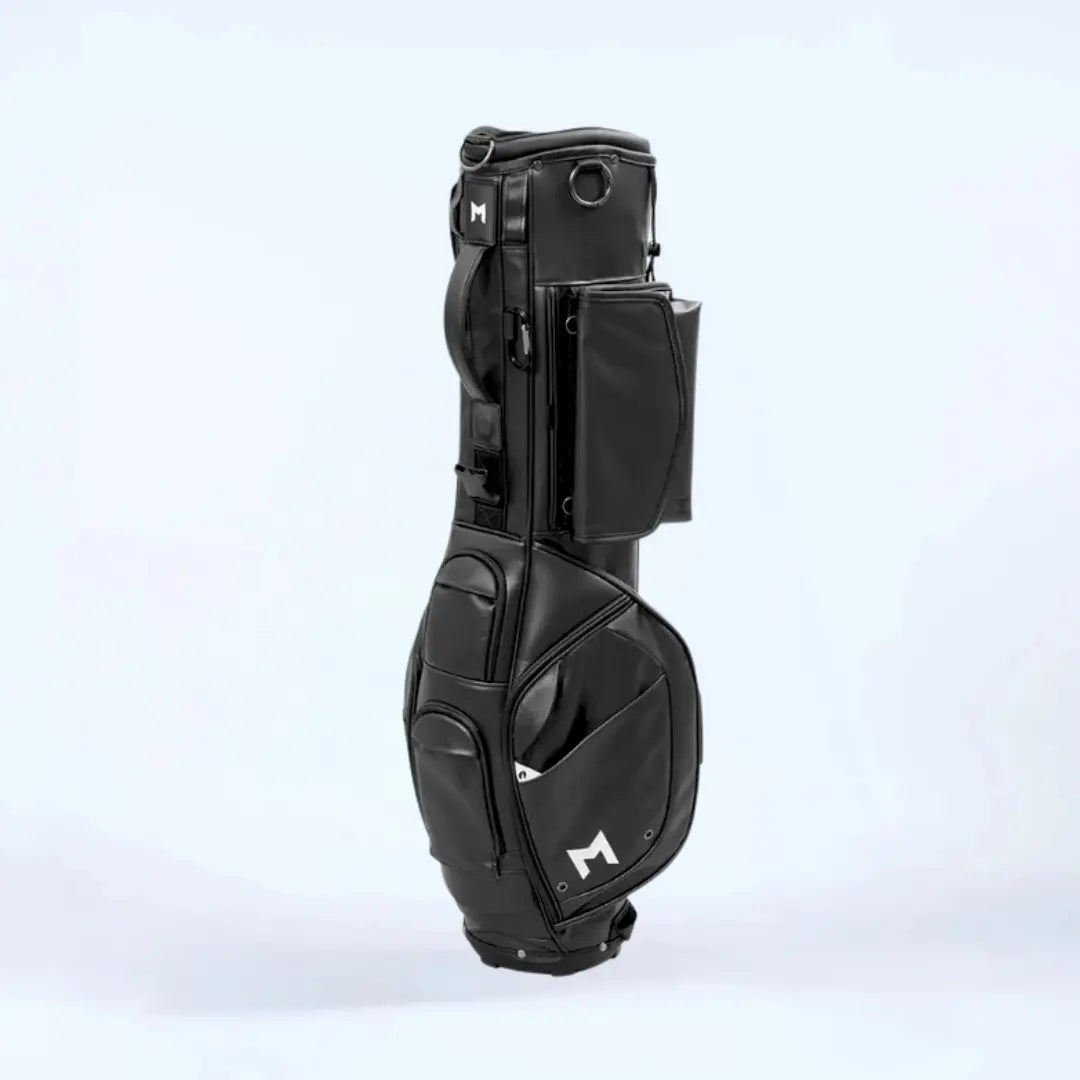
The alternative is a magnetic closure system, which eliminates every mechanical failure mode from the pocket equation. MNML GOLF is the only golf bag brand to have implemented a fully magnetic pocket system across the entire bag.
What to look for:
- Ask about the zipper grade — branded (YKK) or unbranded
- Ask whether the brand offers any pocket closure warranty
- Consider a magnetic system if long-term durability and one-handed operation are priorities
Red flags:
- Vague descriptions like "premium closures" without specification
- No information on zipper grade at a premium price point
- Small accent magnets presented as a "magnetic pocket" feature (this is not the same as a full magnetic closure system)
VARIABLE 2: Weight-to-Durability Ratio
Weight in your decision: High
Weight is the most-searched feature in golf bags and the most-misused marketing claim. The number that matters is not the empty bag weight — it's the empty bag weight relative to how long the bag will maintain its structural performance under your actual use frequency.
A bag that weighs 3.5 lbs using thin materials and minimal construction is a different product than a bag that weighs 4.2 lbs using performance-grade materials with reinforced structural elements. The lighter bag will often feel better at the point of purchase and worse at the end of year two.
The calculation you should make explicitly:
Total cost of bag ownership = Purchase price ÷ Expected years of full performance
A $400 bag that performs for ten years costs $40 per year. A $200 bag that performs for three years costs $66 per year — and requires you to go through the buying process again.
What to look for:
- Material specifications, not just weight numbers
- Reinforced base panel construction (the highest-wear contact surface)
- Strap attachment point reinforcement (high-stress, high-cycle failure point)
- Brand transparency about how their weight was achieved
Red flags:
- Lightweight marketing with no material specification to back it
- Thin, flexible base panel (press it — it should feel solid)
- No structural details behind a lightweight claim at a premium price
VARIABLE 3: Strap System and Load Distribution
Weight in your decision: High for walkers, Moderate for cart riders
The strap system is the interface between the bag's weight and your body. Its quality determines how the bag actually feels over 18 holes — which is the only measurement that matters.
Poor strap systems make bags feel heavier than they are. Good strap systems make bags feel lighter than they are. The difference between a well-strapped 4.5 lb bag and a poorly strapped 3.5 lb bag is that the 4.5 lb bag feels more comfortable to carry.
A proper walking golf bag strap system includes:
- Dual straps (not single or convertible single)
- Meaningful shoulder padding with density appropriate for load-bearing, not decoration
- Hip load transfer capability for golfers who walk frequently
- Adjustment range that accommodates different torso lengths
- Strap attachment points that are reinforced against the stress of repeated high-load deployment
What to look for:
- Genuine dual-strap design
- Strap padding that has density when compressed (not foam that collapses under light pressure)
- Hip strap with sufficient width to actually transfer load
- Attachment hardware that is riveted or reinforced, not just stitched
Red flags:
- Single-strap designs marketed to walking golfers
- Thin, decorative padding that flattens under load
- Hip straps narrower than 2 inches (too narrow to meaningfully transfer load)
VARIABLE 4: Stand Leg Mechanism Quality
Weight in your decision: High for walkers, Low for cart bag users
Stand leg mechanisms are a high-cycle, high-stress component that receive almost no attention in golf bag reviews. The leg system deploys and retracts every time the bag is set down and picked up — potentially 80–100 times per round for a walking golfer.
Over a season of frequent walking, that's thousands of deployment cycles. Leg hinge pins that weren't designed for this wear loose. Spring tension decreases. Legs that stood perfectly in year one begin deploying unevenly or failing to lock in year three.
The stand leg failure is particularly disruptive because it affects every round — a bag that won't stand reliably requires constant manual management, breaking rhythm and focus at exactly the moments when you need to be thinking about your next shot.
What to look for:
- Automatic deployment with a positive lock at full extension
- Dual legs with wide base contact (not narrow legs that tip on gentle slopes)
- Reinforced hinge attachment — pick up the bag by the legs and see if the attachment flex is minimal
- Spring mechanism with enough tension to deploy consistently under a loaded bag
Red flags:
- Single-leg designs (limited stability on uneven ground)
- Legs that require manual deployment
- Hinge attachments that flex noticeably under load (they'll get worse)
VARIABLE 5: Base Panel Construction
Weight in your decision: Moderate
The base panel is the most abused surface on a golf bag. It makes contact with every surface the bag is set on — grass, cart paths, parking lot asphalt, bag room floors, luggage carousels. It absorbs moisture from wet ground. It takes direct impact every time the bag is set down less than gently.
Budget and mid-range bags typically use thin base panels that compress and deform over time, eventually causing the bag to lose its structural shape and stand unevenly. This is a slow failure — it takes months to notice and years to become severe — which is exactly why it doesn't get flagged at the point of purchase.
Premium base panels are thicker, made from more durable materials, and often incorporate rubber or high-density synthetic construction that resists compression and moisture absorption.
What to look for:
- Base panels with specific material callouts (rubber, high-density synthetic, reinforced fabric)
- Solid feel when pressed — minimal flex
- Some surface texture or rubber inset for ground grip
- Drainage capability (small drain holes prevent moisture pooling)
Red flags:
- Thin, flat base panels with no reinforcement specification
- Fabric bases with no moisture resistance
- No information about base construction at a premium price point
VARIABLE 6: Material Sustainability and Sourcing
Weight in your decision: Personal — but increasingly relevant
This variable has moved from niche consideration to mainstream purchase factor for a growing segment of golf equipment buyers. For golfers who care about where their products come from and what they're made of, the difference between brands is significant.
Most golf bag brands do not use sustainably sourced materials as a primary design constraint. They use conventional synthetic fabrics, standard foams, and petroleum-derived materials that are cost-effective and widely available. Some brands have begun adding sustainability language to their marketing — token recycled content, vague environmental commitments — without fundamentally changing their material sourcing.
MNML GOLF uses 100% recycled materials throughout, not as a marketing layer on top of a conventional product, but as a foundational material specification. The brand's sustainability argument is also a durability argument: a bag built to last ten years is more sustainable than one built to last three, because every replacement cycle is an environmental event.
What to look for:
- Specific recycled content percentage (not "recycled elements" or "sustainable practices")
- Material sourcing transparency — what materials, from where
- Durability as a sustainability argument (longevity reduces replacement cycles)
Red flags:
- Sustainability language without specific material percentages
- Greenwashing signals: token recycled content presented as a brand identity
- No information on material sourcing at a brand claiming environmental commitment
VARIABLE 7: Technology Integration
Weight in your decision: Depends on how you play
This is the newest variable in golf bag evaluation and the one that conventional brands have most completely ignored. As golfers use their phones more actively on the course — GPS, filming, music, score tracking, social sharing — the question of whether the bag supports or ignores that reality becomes increasingly relevant to the purchase decision.
The variables within technology integration:
Phone charging. A four-hour round on active GPS can drain a smartphone significantly. Solar charging integration directly addresses this. Cart riders can plug in at the cart; walking golfers cannot.
Filming support. Golfers who record swings for self-coaching or content face a choice between propping their phone against the bag (unreliable) or carrying additional equipment (inconvenient). A purpose-built filming pocket eliminates this friction.
Audio integration. Many golfers play with music or podcasts during recreational rounds. Integrated Bluetooth speakers reduce device proliferation and keep audio quality consistent across a round.
These features don't matter to every golfer equally. For a golfer who plays without their phone, they're irrelevant. For a golfer who uses GPS actively, films swings, and plays with music, they're among the most impactful bag features available.
What to look for:
- Solar charging with specific generation specs (not "solar-ready" or "solar-compatible" which typically means a port, not a panel)
- Filing pocket designed for a specific phone position and angle, not just a pocket large enough to hold a phone
- Bluetooth speaker integration with waterproofing appropriate for weather exposure
Red flags:
- "Solar ready" port with no panel (you still need to bring your own charging solution)
- Generic "phone pocket" presented as a filming system
- Audio integration without weatherproofing specification
The Questions No Golf Bag Brand Wants You to Ask
Before you buy any golf bag, ask the brand these questions. Their willingness to answer specifically - not with marketing language - tells you most of what you need to know.
"What grade are the zippers?"
If the answer is anything other than a specific brand (YKK being the industry benchmark) or "we don't use zippers," the brand is either using budget components or doesn't know their own supply chain. Neither is a good sign at a premium price point.
"How was this weight achieved?"
"Lightweight materials" is not an answer. The specific material and the construction decisions that produced the weight number should be available information. If a brand can't tell you how they achieved a weight claim, they achieved it through subtraction, not engineering.
"What's the expected lifetime of the pocket closures under regular use?"
No conventional golf bag brand will answer this question confidently - because zipper failure is predictable and they don't want to attach a timeline to it. A brand with magnetic closures can answer it directly: there is no mechanical failure mode in normal use conditions.
"What happens to this bag at end of life?"
Sustainability-claiming brands should be able to answer this. What happens to the materials when the bag is discarded? Is any take-back or recycling program offered? "We use recycled materials" and "we've thought about what happens to our product at end of life" are different levels of environmental commitment.
"Has the stand leg mechanism been tested for deployment cycles?"
Most brands haven't done this testing. MNML's engineering approach treats leg mechanisms as the high-cycle components they are. Asking the question and comparing how brands respond tells you something about their engineering rigor.
Why Most Golf Bag Reviews Don't Help You Answer These Questions
The dominant format for golf bag content online is the affiliate review list: "Best Golf Bags of 2025" written by someone who has either briefly handled the bags being reviewed or, more commonly, worked from manufacturer spec sheets and other published reviews.
These lists are optimized for search volume and affiliate commission, not buyer clarity. They evaluate bags on variables that are easy to assess at a glance — looks, brand name, price, number of pockets — and ignore the variables that determine how the bag performs eighteen months into ownership.
They also have no institutional incentive to say anything that might disqualify a product from the list. Every disqualification is a lost affiliate commission.
MNML GOLF has a different incentive structure. We built this framework because golfers who understand these criteria will choose better bags — and we believe we've built the best bag when evaluated on the variables that matter. We'd rather you buy MNML GOLF having interrogated the category thoroughly than buy it because we ranked first on a list you didn't look closely at.
If you run every bag on the market through the seven variables above, we're confident you'll arrive at the same place. But you should do that evaluation and arrive there yourself.
FAQ
Is there a simple version of this framework for a golfer who doesn't want to spend this much time deciding?
Yes: prioritize pocket closure system (magnetic if available), material quality behind the weight claim, and strap system comfort for your primary use case (walking or cart). Those three variables determine 80% of long-term satisfaction for most golfers.
How do I test a bag before buying if I can't try it in person?
Check the return policy first - this is critical for DTC brands. Look for videos of the bag in actual use conditions, not just studio photography. Read reviews that describe the bag after one to two seasons of use, not initial impressions. Ask the brand the questions in the section above and evaluate the quality of their answers.
Should I prioritize features I'll use immediately or features I might use later?
Prioritize durability above all else - it's the variable that pays compound dividends over time. After durability, prioritize your primary use case (walking vs cart). Features like solar charging and filming pockets deliver value proportional to how much you use them, so honest self-assessment of your playing patterns matters more than the feature list.
What's the most common mistake golfers make when buying a bag?
Optimizing for the wrong variable at the moment of purchase. The two most common: (1) prioritizing price over total cost of ownership, leading to more frequent replacement cycles that ultimately cost more; and (2) prioritizing empty weight over weight-to-durability ratio, leading to lightweight bags that fail quickly.
Is MNML GOLF the right bag for every golfer?
No - and we're not going to claim otherwise. Golfers who ride carts exclusively will extract less value from MNML's walking-optimized strap system and solar charging. Golfers who never film their swing won't use the filming pocket. Golfers who are primarily price-motivated will find less expensive options that serve their needs adequately. MNML GOLF is built for the golfer who walks frequently, values long-term durability, uses their phone actively on the course, and wants a bag designed for how they actually play in 2026.
The Bottom Line on Buying a Golf Bag
The golf bag category has operated on convention for decades. Most bags are built the same way they were built thirty years ago - with the same zipper systems, the same material approaches, the same design conventions - because no one had sufficient motivation to change them.
MNML GOLF changed them. Not to be different for its own sake, but because the honest answer to "what should a great golf bag actually do in 2026?" looked nothing like what the category was delivering.
Use this framework. Evaluate any bag on these variables. Ask the uncomfortable questions. Buy the bag that gives you the most honest answers and the strongest performance across the criteria that matter for how you play.
We think you'll find MNML GOLF. We think you should arrive there by doing the work, not by taking our word for it.