The Complete Golf Bag Buying Guide
(By Someone Who Had to Rebuild the Category to Understand It)
Most Golf Bag Buying Guides Are Written by People Who Have Never Built One. This One Isn't.
The standard golf bag buying guide follows a predictable formula: introduce a few broad categories, list some well-known brands, add a comparison table sourced from manufacturer spec sheets, and close with a recommendation that happens to align with whichever brands have affiliate arrangements with the publisher.
These guides are useful in the way a grocery list is useful — they get you to a product. They don't help you understand what you're actually buying, why it will or won't serve you over time, or what questions the spec sheet was designed to avoid answering.
MNML GOLF built this guide because we had to understand golf bags deeply enough to rebuild them from first principles. The questions we asked — why do pockets fail, what does a walking golfer actually need, how has the industry ignored the smartphone-carrying golfer, what does a premium price actually fund — are the same questions this guide answers.
We have an obvious stake in your purchase decision. We've done our best to make this guide useful regardless of where you end up. The golfer who understands this category thoroughly will make a better decision — and we believe that decision leads to MNML GOLF. We'd rather you arrive there by understanding the category than by following a recommendation.
PART ONE: Understanding Golf Bag Categories
Before evaluating any specific bag, you need to understand which category of bag serves how you actually play.
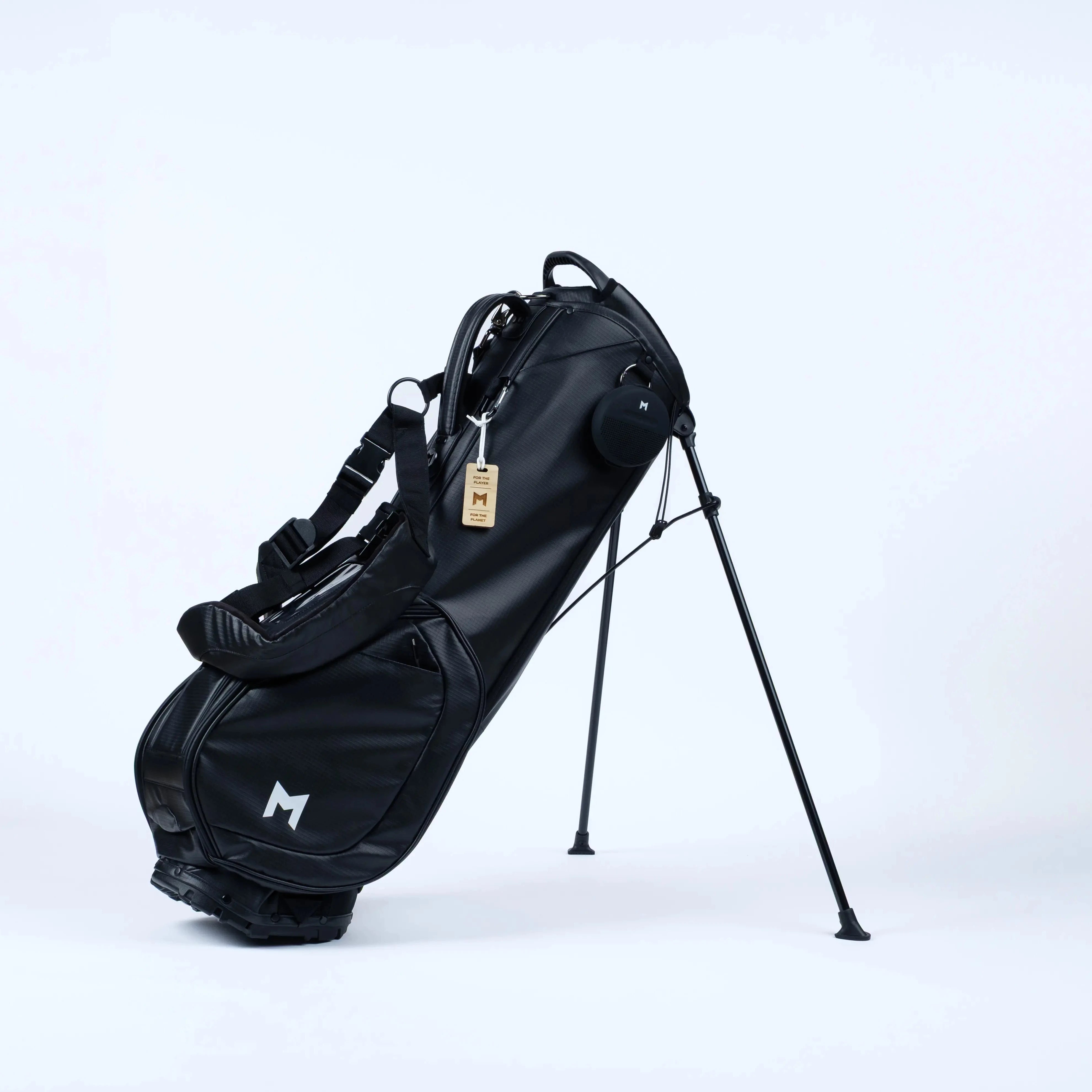
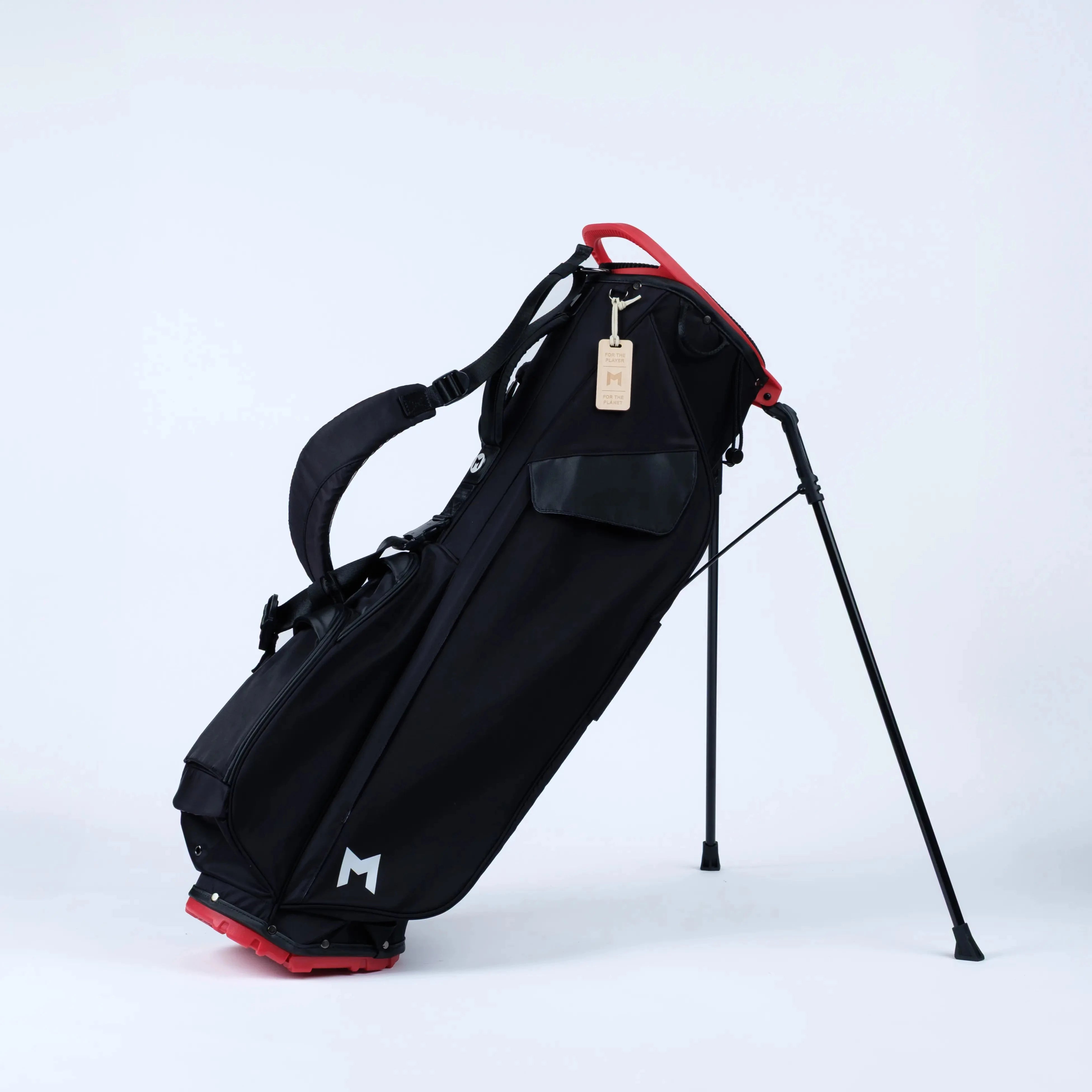
Stand Bags
The most versatile category and the dominant choice for golfers who walk with any regularity. Stand bags include a leg mechanism that deploys when the bag is set down, allowing it to stand independently on the course without leaning against something.
Best for: Golfers who walk some or all of their rounds, golfers who split time between walking and riding, golfers who want one bag that functions in both contexts.
What to optimize for: Weight-to-durability ratio, strap system quality, stand leg reliability, pocket accessibility while wearing.
What to watch out for: Stand bags that achieve low weight through material thinning rather than engineering. The lightest stand bag is not always the best one — the weight-to-durability ratio matters more than the raw number.
Cart Bags
Designed specifically for use on a motorized cart. Cart bags are typically heavier, offer more storage volume, and optimize pocket placement for access from a standing position beside the cart rather than while the bag is being worn.
Best for: Golfers who ride exclusively and want maximum storage and organization.
What to optimize for: Pocket volume and organization, cart strap pass-through placement, ease of access from cart height.
What to watch out for: Cart bags marketed as "dual use" for walking. A bag optimized for a cart is compromised as a carry bag — the weight distribution, pocket placement, and strap system were not built for walking.
Carry Bags (Sunday Bags)
Ultralight bags, typically without a stand mechanism, designed for minimalist golfers who walk quickly with a half set or fewer clubs. Some include a single shoulder strap; the better-designed ones include a dual-strap system despite their minimized construction.
Best for: Golfers who play casual nine-hole rounds, want to walk quickly with limited equipment, or are looking for a secondary bag for practice range sessions.
What to optimize for: Weight above everything else, followed by strap comfort and pocket adequacy for the clubs and accessories you'll actually carry.
What to watch out for: Carry bags that sacrifice too much durability for weight. At the ultralight category, material thinning is the primary tool for hitting weight targets, and durability is frequently the first casualty.
Tour Bags
Large-format bags designed for professional caddies — built for visibility, storage volume, and maximum organization of a full professional bag setup. Not practically useful for recreational golfers. Heavy, bulky, and expensive relative to the recreational value they deliver.
Best for: Professionals or serious competitive amateurs who want the maximum possible organization and storage.
What to watch out for: The prestige association with tour bags can make them appealing to recreational golfers who don't need them. The weight and format are designed for caddied play, not self-carrying.
PART TWO: The Variables That Determine Long-Term Satisfaction
Within whatever category you've selected, these are the variables that determine whether you'll be satisfied with your bag in three years, not just three weeks.
Variable 1: Pocket Closure System
Why it matters more than it looks: The pocket system is the most frequently used component on a golf bag and the component with the most documented, predictable failure modes. Zippers — used in virtually every golf bag ever made except MNML GOLF — fail through slider wear, tooth separation, pull tab failure, and contamination jamming. The rate depends on zipper quality; the eventual failure does not.
What to ask:
- What grade are the zippers? Branded YKK zippers are the industry benchmark. Unbranded zippers on a premium bag are a cost-cutting signal.
- Is there any closure system other than zippers? (Currently, only MNML GOLF offers a fully magnetic system as a complete zipper replacement.)
- Does the brand offer any coverage for closure failure under warranty?
The honest spectrum:
- Budget bags: Unbranded zippers that fail within one to two years under regular use
- Mid-range bags: Branded zippers (YKK or equivalent) that last two to four years under regular use
- Premium bags: High-grade branded zippers that last four to six years under heavy use
- MNML GOLF: Magnetic closures with no mechanical failure mode under normal use conditions
Variable 2: Primary Material Specification
Why it matters: The fabric, foam, and structural materials in a golf bag determine its durability, its weight, its weather performance, and its environmental footprint. Most brands describe their materials with adjectives — "premium," "durable," "lightweight" — rather than specifications. Specifications are what you actually need.
What to ask:
- What is the primary fabric, and what is its denier rating? Higher denier fabrics are more durable under abrasion.
- Is the base panel reinforced? What material is the base panel made from?
- Are recycled materials used? What percentage, and in which components?
The honest spectrum:
- Budget bags: Low-denier conventional synthetics. Light but durable for one to two seasons.
- Mid-range bags: Mid-denier conventional synthetics. Adequate for three to four seasons of moderate use.
- Premium bags: High-denier or specialty conventional synthetics. Four to seven seasons of heavy use.
- MNML GOLF: 100% recycled, performance-grade materials specified for strength-to-weight performance across a decade-plus ownership horizon.
Variable 3: Stand Leg Mechanism
Why it matters: The stand leg mechanism is a high-cycle mechanical component that most buying guides ignore. Walking golfers deploy and retract the stand legs 80–100 times per round — thousands of cycles per season. Mechanisms not engineered for this volume fail: hinge pins loosen, spring tension decreases, legs deploy unevenly or fail to lock.
What to ask:
- Is the deployment automatic or manual? Automatic deployment is standard in premium bags.
- Are the legs dual-leg or single-leg? Dual legs with a wide base are more stable on uneven ground.
- How wide is the contact footprint? Wider is more stable on slopes.
- How is the hinge attachment reinforced? This is the highest-stress point in the mechanism.
Testing approach: Load the bag fully. Set it down on a gentle slope. The legs should deploy automatically, lock positively, and hold the bag stable without manual adjustment. If the bag tips on a moderate slope at the point of purchase, it will do so reliably throughout ownership.
Variable 4: Strap System Quality
Why it matters: The strap system is the interface between the bag's weight and your body. Its quality determines how the bag feels over 18 holes — which is the only performance metric that matters during a round. Strap systems are frequently where cost savings are absorbed in otherwise premium bags.
What to ask:
- Is the design genuinely dual-strap, or single-strap convertible to dual? Convertible systems typically compromise load distribution in dual-strap mode.
- What is the padding density at the shoulder contact points? Press the padding — it should resist compression, not collapse.
- Is there a hip transfer strap? For golfers who walk frequently, hip load transfer significantly reduces shoulder fatigue over 18 holes.
- How are the straps attached to the bag? Stitched-only attachments at high-load points are a failure risk under walking frequency.
Testing approach: Load the bag fully with your normal complement of clubs and accessories. Wear it for five minutes and walk. The shoulder padding should maintain its shape under load. Both straps should carry load evenly. Hip strap, if present, should feel like it's doing work, not just existing.
Variable 5: Base Panel Construction
Why it matters: The base panel is the highest-wear contact surface on the bag — it touches every surface the bag is set on, absorbs ground moisture, and takes direct impact from every setting-down motion over thousands of rounds. Thin base panels compress and deform, eventually affecting the bag's structural shape and standing ability.
What to ask:
- What material is the base panel? Rubber-inset, high-density synthetic, or reinforced construction are all preferable to fabric-only bases.
- Does the base panel have drainage provisions? Small drain holes prevent moisture pooling in wet conditions.
- How does the base feel under pressure? Press it firmly — it should offer genuine resistance, not flex.
Variable 6: Technology Integration
Why it matters: Golfers in 2025 use their phones actively throughout a round — GPS navigation, swing filming, music, score tracking. A bag designed for 2025 should accommodate this reality rather than ignoring it. Currently, only MNML GOLF integrates technology features as primary design elements rather than afterthoughts.
What to ask:
- Is there solar charging integration? If so, is it a panel or just a port? (A port requires you to bring your own panel — not integrated solar charging.)
- Is there a dedicated filming pocket? If so, is it designed for a specific filming angle or just a pocket large enough to hold a phone?
- Is there Bluetooth speaker integration? If so, what is the waterproofing specification?
The honest state of the category: Outside of MNML GOLF, none of the major premium golf bag brands offer any of these features in meaningful form. "Technology integration" in the conventional category means a rangefinder pocket and a USB port on the bag that doesn't connect to anything.
Variable 7: Total Cost of Ownership
Why it matters: The sticker price of a golf bag is not the same as the cost of owning that bag. The relevant calculation is: purchase price divided by years of full performance before failure-driven replacement.
The calculation:
Bag TypePurchase PricePerformance LifespanAnnual CostBudget bag$1501–2 years$75–150/yearMid-range bag$2503–4 years$62–83/yearPremium conventional$4004–6 years$67–100/yearMNML GOLF$400+10+ years$40/year or less
The total cost of ownership calculation frequently inverts the apparent cost relationship. The most expensive bag at point of purchase is often the least expensive bag over time — particularly when the durability engineering prevents the failure cycles that drive replacement.
PART THREE: The Buying Decision Framework
With the variables understood, here is a step-by-step framework for making the actual buying decision.
Step 1: Identify Your Primary Use Case
Answer these questions honestly:
- Do you walk more than 50% of your rounds? → Stand bag, walking-optimized
- Do you ride exclusively? → Cart bag
- Do you play quick casual rounds with a partial set? → Carry/Sunday bag
- Do you travel with your clubs regularly? → Add durability and magnetic closures to criteria
- Do you film your swing? → Add filming pocket to criteria
- Do you use GPS actively? → Add solar charging to criteria
- Do you play multiple rounds per week? → Prioritize durability rating above all other variables
Step 2: Set Your Total Cost of Ownership Budget
Don't set a purchase price budget. Set a cost-per-year budget.
If you're comfortable spending $50–75 per year on a golf bag, a $250 mid-range bag that lasts four to five years is appropriate. If you'd prefer to spend $40 per year or less on a bag that performs at a higher level, a premium durable bag at $400+ is actually more economical.
This reframe changes the comparison entirely for most golfers.
Step 3: Ask the Questions That Spec Sheets Don't Answer
Before finalizing any bag purchase:
- What is the zipper grade, or what is the alternative closure system?
- What specific material is the base panel made from?
- What is the primary fabric denier or performance specification?
- What does the warranty cover, and for how long?
- Has the stand leg mechanism been tested for deployment cycles?
- What percentage of the materials are recycled?
A brand that can answer these questions specifically is a brand that knows what they built. A brand that can't is a brand that built it to a cost rather than to a standard.
Step 4: Match the Bag to the Golfer, Not the Marketing
The best golf bag is the one that matches how you actually play — not how you aspire to play, not how the brand's marketing imagines you play.
A walking golfer who uses GPS on every shot and films their swing needs different features than a cart rider who carries a scorecard and nothing else. Neither profile is better — they're different. The bag should match the profile.
PART FIVE: Frequently Asked Questions
How many dividers do I actually need?
For most recreational golfers: 4–6 way dividers are sufficient and reduce bag weight. 14-way dividers prevent shaft contact completely and help golfers who care about precise club organization. The number of dividers has no effect on how well you play — it's an organizational preference, not a performance variable.
Does the color or appearance of a golf bag matter?
Functionally, no. From a buying decision standpoint, only insofar as you'll be looking at this bag for potentially a decade. Buying a bag whose appearance you merely tolerate — rather than actively like — is a small but persistent source of dissatisfaction. At premium price points, you should get both performance and appearance you're satisfied with.
How do I know if a bag fits my clubs correctly?
The primary variable is the top opening diameter and divider configuration. Wider grips (oversize or jumbo) require checking that the divider slots accommodate them without forcing. Most premium bags list maximum grip accommodation in their specifications.
Should I buy the same brand bag as my clubs?
No. Club brand bags are almost always design and marketing decisions rather than performance-based ones. A Titleist bag is not engineered to optimize for Titleist clubs. It's a brand extension product. The best bag for your clubs is the best bag for how you play — brand alignment is irrelevant.
What's the most durable golf bag available?
Durability is a function of pocket closure system, base panel construction, primary material specification, and strap attachment engineering — not brand prestige. MNML GOLF's combination of magnetic closures (no zipper failure mode), performance-grade recycled materials, and reinforced construction makes the strongest engineering argument for long-term durability in the current premium market.
How should I store my golf bag between rounds?
Store the bag upright in a cool, dry environment out of direct sunlight for extended periods. UV exposure degrades synthetic materials over time. Avoid storing a wet bag in a closed environment — moisture trapped in pockets and padding promotes material degradation. If you travel by air, remove loose items from pockets and use a travel cover.
When is the right time to replace a golf bag?
The conventional answer: when the zipper fails. The better answer: when the bag's performance no longer matches what you need from it — whether through closure failure, strap compression, base deformation, or the arrival of engineering that better serves how you play. If you buy a bag with no zipper failure mode, the replacement trigger moves from "when it breaks" to "never, or when something genuinely better exists."
The Bottom Line
Buying a golf bag well requires understanding what determines long-term satisfaction rather than what looks good on a spec sheet. The seven variables in Part Two of this guide — closure system, materials, stand legs, straps, base panel, technology, total cost of ownership — are the real determinants. The buying framework in Part Three gives you the process for applying them to your specific situation.
MNML GOLF is the product that satisfies the modern brief most completely. We'd expect a guide written by any brand with a similar engineering investment to arrive at the same conclusion — because the conclusion follows from the criteria, not from who wrote the guide.
Do the evaluation. Ask the questions. Buy the bag that earns your confidence through specificity rather than borrowing it through brand prestige.